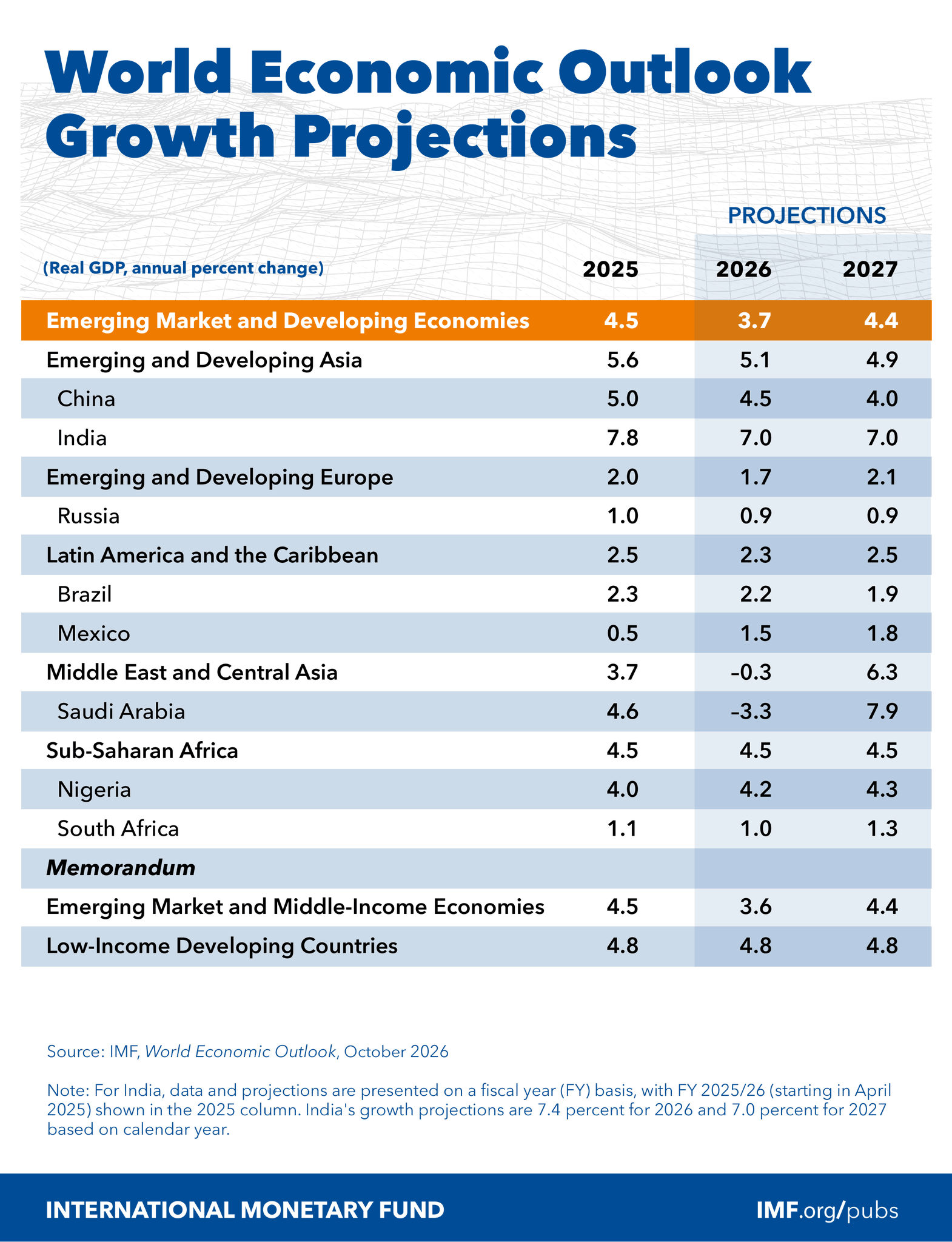
The forecast is from the IMF's October 2026 World Economic Outlook titled "Resilience Under Strain, Urgent Choices" released today in Bangkok. Global growth is projected at 3.1% in 2026 from 3.5% in 2025, then 3.4% in 2027.
IMF says growth is being reallocated, not just slowing. Countries hit by Middle East war energy shock are dragging, while AI-linked economies are holding up.
Why 3.7% in 2026? The 4 drivers IMF cities
1. Commodity dependence:
Energy exporters outside conflict zone are cushioned by better terms of trade. Oil at $96/bbl average in 2026 (16% above April reference) and gas at $20/MMBTU helps them.
Energy importers with no tech link face higher import bills, currency depreciation, weaker real incomes. Many low-income countries fall here. Gap between rich and poor emerging economies widens.
2. Sensitivity to financial conditions:
Higher global inflation 4.7% in 2026 vs 4.1% in 2025 means higher rates for longer. Commodity-importing emerging economies with weak fiscal buffers face financing stress, capital outflows. Fiscal policy expected to tighten gradually.
3. Policy frameworks:
Countries with credible fiscal consolidation, flexible exchange rates, and inflation-targeting monetary policy absorb shocks better. IMF notes buffers like inventory drawdowns and rerouting have cushioned initial shock but are depleting - global oil inventories drawing down 2.7M barrels per day near stress levels.
4. Position in Global technology value chain:
This is the big divider. Economies integrated into AI supply chain - Taiwan, Korea, Malaysia, Mexico linked to US hyperscalers - get AI investment boom offsetting energy drag. India shows resilient domestic demand + robust services at 7.0% growth in 2026-2027 despite oil prices.
Those with little link to tech chain face compounding strains. AI readiness and reliable energy to meet AI power demand will be crucial.
Regional picture inside 3.7%:
- Emerging and Developing Asia: 4.9% in 2026 from 5.5% in 2025, then 4.8% in 2027. China 4.5% in 2026 from 5.0%, then 4.0% in 2027 on oil + structural headwinds. India fastest major economy at 7.0%.
- Middle East and Central Asia: Contract -0.3% in 2026, then rebound 6.3% in 2027 - worst hit by Strait of Hormuz closure since Feb 27 2026. 20M barrels per day route disrupted, oil peaked $126 in March.
- Sub-Saharan Africa: Faces higher import bills and weaker currencies, cumulative growth revised down 0.5pp for 2026-2027 vs January.
Assumptions behind recovery to 4.4% in 2027
IMF assumes Strait of Hormuz reopens March 2027 with return to prewar conditions broadly by October 2027. Gradual restoration of production, shipping, insurance, not immediate normalization. AI tech cycle stabilizes, productivity growth consistent. If war broadens or oil stays elevated, damage deepens.
Risks tilted down: prolonged stalemate, commodity volatility, physical supply disruptions, AI equity correction.
FAQ
Why is emerging market growth slowing to 3.7% in 2026?
Down from 4.5% in 2025 due to energy shock from Middle East war, higher inflation 4.7%, tighter financial conditions, and uneven exposure to AI boom. Commodity importers with weak policy buffers hit hardest.
Which emerging markets will recover fastest?
Those in global tech value chain and with strong domestic demand. India projected 7.0% in 2026-2027, Emerging Asia 4.9%. Energy exporters outside conflict also cushioned. Middle East/Central Asia to rebound to 6.3% in 2027 after contraction.
How does commodity dependence affect growth?
Net exporters benefit from higher oil/gas prices improving terms of trade. Net importers face higher import bills, currency pressure, weaker real incomes, and inflation - especially low-income countries lacking inventories.
What is global technology value chain role?
Countries supplying chips, hardware, services for AI infrastructure get investment and trade boost that offsets energy drag. IMF says AI readiness and ability to reliably meet energy needs for AI will be crucial for future growth differentiation.
Will growth really recover to 4.4% in 2026?
IMF baseline assumes Strait of Hormuz reopens March 2027 and energy prices ease. If conflict continues or inventories hit stress, recovery could be delayed. Fiscal tightening and high debt also weigh.
Also read this: https://afterpostint.com/post/p-strong-imf-warns-ai-crash-bond-yields-cyber-top-market-risks-strong-p