"These risks by themselves do not necessarily threaten financial stability but could become systemic if they are amplified by underlying vulnerabilities," the IMF said. Financial stability risks remain elevated.
Proactive policies today can prevent bigger shocks tomorrow, the IMF wrote in its blog based on Chapter 1 "Beneath the Resilience: Rising Risks, Unresolved Vulnerabilities."
AI correction - the biggest bubble risk
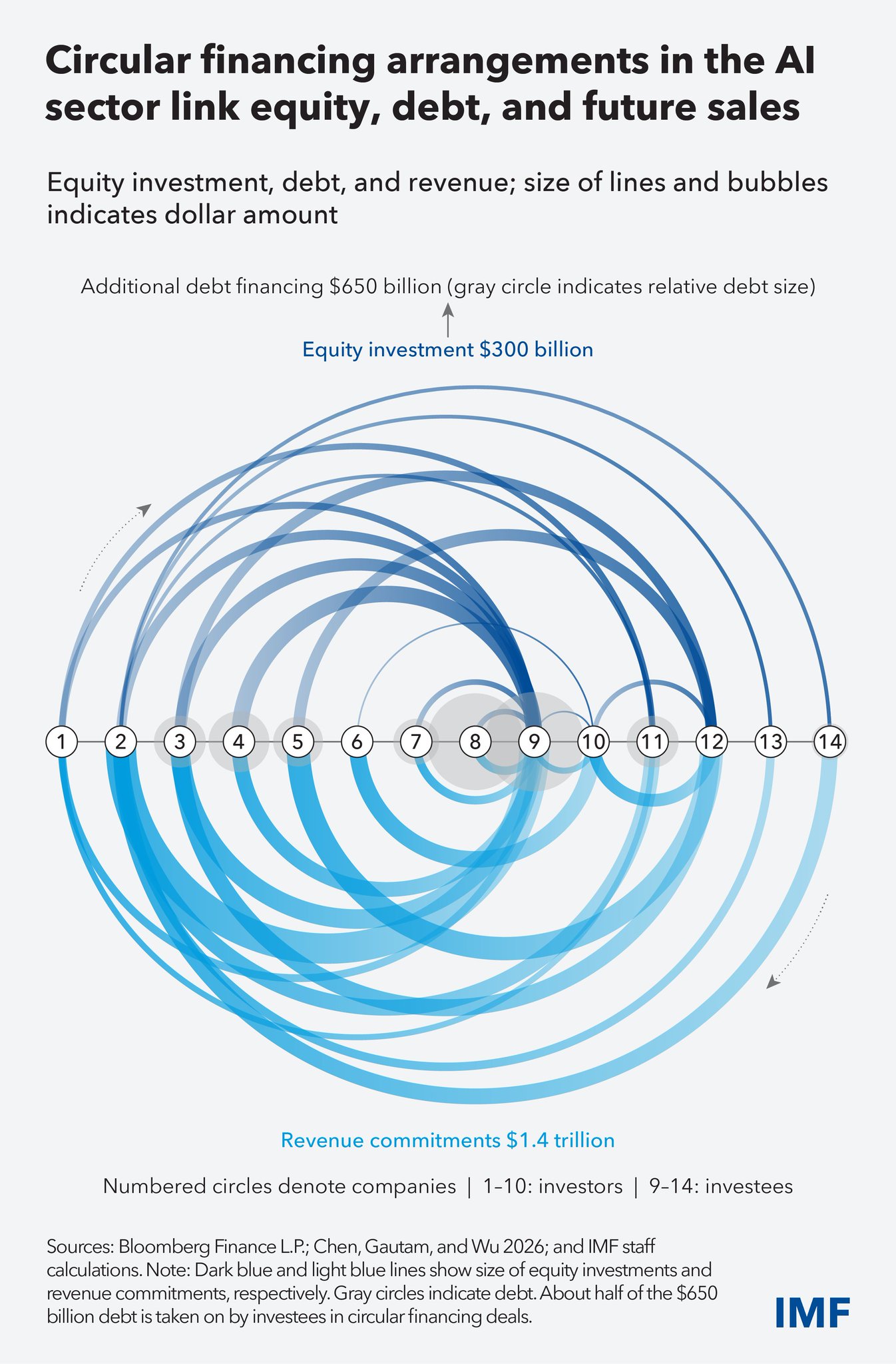
AI has propped up growth while Middle East war and trade friction dragged. Hyperscalers delivered exceptional earnings and now represent 10% of global investment-grade bond issuance, up from less than 1% in 2024. IMF notes $300B in equity and $650B in debt tied to $1.4 trillion in future revenue commitments in circular AI deals.
But there is growing evidence AI capabilities may not require as much investment, or gains may not be as large as expected. If investment or profitability wanes, it could trigger a broad correction.
Leverage makes it worse: derivatives, margin loans, retail borrowing to speculate on AI stocks. Forced selling could spill globally. Asian markets and US are most exposed.
"The consequences of an AI correction could be global," IMF warned. It called to curb leverage where excessive.
Bond yield shock - disorderly spike
Government bond yields in advanced economies have hit multidecade highs on higher energy prices and inflation. IMF says bond market risks worsened since April.
With public debt near WWII highs and set to exceed 100% of GDP, high debt and rollover risk make bond markets susceptible to fiscal and inflation shocks. More price-sensitive investors, weaker liquidity, and AI firms competing for investor cash add pressure.
A sharp rise in yields would mark down asset values through higher discount rates, including AI assets, and erode collateral value of bonds used in repo transactions. Hedge funds have unwound some repo borrowing without turmoil so far, but IMF warns of severe impact given foundational importance of sovereign bond markets.
Cyberattacks- the underestimated threat
Technological reliance on few critical providers makes cyber defense harder. In over 70% of cases in 2026, software providers had almost no time to patch vulnerabilities before exploitation, up 20 points from last year. AI helps defense but also makes attacks more sophisticated.
IMF warns a major attack on a critical service or financial institution could undermine confidence and ripple quickly. It called for better incident reporting and resilience testing and stricter oversight of third-party tech vendors.
Vulnerabilities beneath
IMF stress tests show bank capital cushions remain robust, but pockets of weakness grow. Banks representing 22% of global banking assets have weak capital under stress, up from 18% in 2025. Pension funds and insurers increased illiquid assets, derivatives, and same asset managers, risking simultaneous selling via margin calls. Private credit with funding-on-demand commitments could amplify stress.
What IMF says to do
- Put public debt on sustainable path
- Limit leverage and liquidity mismatches in AI, private credit, nonbanks, including sectoral capital and concentration requirements
- Strengthen cyber defense capabilities
- Emerging economies should rebuild buffers while conditions still accommodative
FAQ
What are IMF 's 3 biggest risk to markets today?
An AI-driven market correction, a sharp rise in sovereign bond yields, and a major cyberattack. IMF listed them Oct 13 2026 as plausible catalysts for market turmoil.
Could an AI crash cause a financial crisis ?
Not directly, but amplified by leverage and interconnectedness it could become systemic. IMF warns of circular financing, $650B debt, margin loans that could trigger forced selling across asset classes.
Why are rising bond yields a risk?
High debt near 100% of GDP means even small yield spikes increase rollover costs, markdown asset values, and reduce collateral value. Could lead to disorderly repricing.
How real is cyberattack risk to finance?
Very. 70% of vulnerabilities exploited before patching in 2026. Attack on critical financial institution could undermine confidence and ripple through markets quickly.
Are banks safe if these risks hit?
Mostly. IMF says core system resilient, but 22% of global banking assets show weak capital under severe AI + bond shock scenario, up from 18% last year.
Also read this: https://afterpostint.com/post/p-strong-poland-pegasus-scandal-israel-had-access-to-polish-data-strong-p