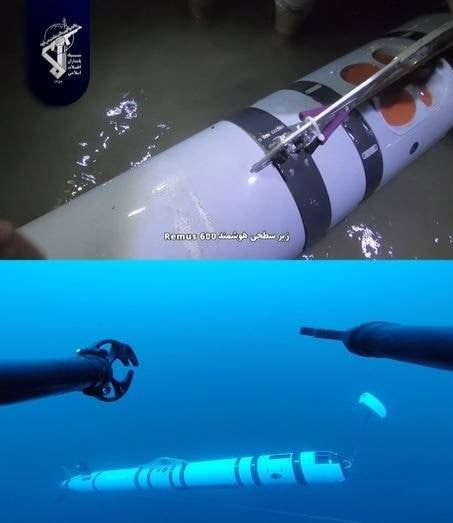
Iran's Islamic Revolutionary Guard Corps (IRGC) Navy announced Sunday that it has captured a second advanced American unmanned underwater vehicle (UUV) in the Strait of Hormuz, identifying it as a REMUS 600 autonomous drone allegedly conducting surveillance operations in the strategic waterway.
If the Iranian claim holds, it marks a significant escalation in the undersea shadow war now unfolding in parallel with the months-long Middle East conflict that has blockaded Hormuz since late February.
What Iran Announced
In its Statement No. 17, released via Sepah News and Iranian state TV, the IRGC Navy said:
> "Through a coordinated, complex operation involving intelligence oversight and electronic warfare, IRGC naval forces' personnel successfully captured an advanced unmanned underwater vehicle belonging to the terrorist U.S. military."
Key details from the Iranian account:
1. *Vehicle type:* REMUS 600 – an advanced, intelligent autonomous underwater vehicle developed by Huntington Ingalls Industries (HII)
2. *Location:* Inside the Strait of Hormuz, which Iran declares "closed"
3. *Method:* Coordinated electronic-warfare operation, not a simple recovery
4. *Status:* Seized intact and handed to IRGC specialists "for data recovery"
5. *Footage:* IRGC released underwater video showing IRGC divers/naval forces retrieving the yellow-bodied UUV
The statement opened with Verse 21 of Surah Al-Fath and concluded with a warning: "The Strait of Hormuz is closed, and we are confronting dangerous maneuvers and unauthorized transit through the Strait resolutely and without pause."
Not the First Time – A Pattern Emerging
This is the second such capture this month.
On *September 8*, the IRGC announced capture of another U.S. UUV near the entrance to Hormuz – identified as a *Dive-LD*, an ultra-long-endurance autonomous vehicle built by Anduril Industries and delivered to the U.S. Navy's Unmanned Undersea Vehicle Group 1 in 2025.
In that first case, the Pentagon pushed back. A spokesperson said the Dive-LD had "malfunctioned more than a day before Iran announced the seizure" and had been conducting routine survey operations.
Tehran is now drawing a sharp contrast: unlike the first drone, which Washington dismissed as a malfunction, the IRGC insists this REMUS 600 was *actively intercepted* through electronic warfare and taken fully intact.
That distinction matters. A malfunctioned drone washing up is an embarrassment. An intact drone hijacked via EW is an intelligence coup.
What Is the REMUS 600? Why It Matters
The REMUS 600 is not a toy. It is a workhorse of U.S. naval undersea surveillance:
- *Length:* ∼3.25m, *Diameter:* 32cm, *Weight:* ∼240kg
- *Depth rating:* Up to 600 meters
- *Endurance:* Up to 22+ hours, range ∼140 nautical miles
- *Payloads:* Side-scan sonar, synthetic aperture sonar, acoustic Doppler, environmental sensors, and crucially – mine-countermeasure and intelligence, surveillance, reconnaissance (ISR) modules
- *Users:* U.S. Navy, U.S. Special Operations Command, Royal Navy, and others
In Hormuz, a REMUS 600 would likely be mapping the seabed for Iranian mines, monitoring IRGC fast-attack craft and Kilo-class submarines, or surveying underwater chokepoints for safe passage of U.S. warships.
If Iran can extract its mission logs, sonar maps, navigation waypoints, and communications encryption, as it claims, the reverse-engineering risk for the U.S. is serious.
Iran has precedent here. After capturing the RQ-170 Sentinel stealth drone in 2011 via alleged GPS spoofing, Iran reverse-engineered it into the Shahed-171 Simorgh. Western analysts fear a similar playbook with UUVs.
The Bigger Battlefield: Hormuz Blockade
Context is critical. Before the Middle East war erupted in late February 2026, the Strait of Hormuz carried ∼20% of global oil and LNG.
Since then:
- *Iran* has maintained a blockade of Hormuz, using mines, anti-ship missiles, IRGC Navy swarms, and now UUV interceptions to enforce what it calls a "restricted zone."
- *The U.S.* has imposed a counter-blockade of Iranian ports, choking Tehran's oil exports.
Commercial shipping has been devastated. Insurance rates are at record highs. The undersea domain has become the new front line – quieter than airstrikes, but potentially decisive.
Capturing U.S. drones serves three Iranian goals:
1. *Intelligence:* Extract U.S. Navy survey data on Iranian minefields and submarine routes
2. *Propaganda:* Show domestic audiences Iran can blind American eyes
3. *Deterrence:* Warn Washington that its undersea ISR network is vulnerable
U.S. Silence – What to Watch
As of Sunday evening, U.S. Central Command (CENTCOM) and the Pentagon have not confirmed the loss.
That silence is telling. Options for Washington:
- Acknowledge and downplay (as with Dive-LD)
- Deny and claim footage is old/doctored
- Say nothing to avoid confirming capabilities
Analysts will be watching for:
- Any NOTAM or naval safety warning about lost UUV in Hormuz
- Satellite imagery of IRGC naval base at Bandar Abbas where the drone was likely taken
- Whether Iran displays the REMUS 600 on state TV in coming days, as it did with the Dive-LD
Until then, this remains an *Iranian claim with video evidence but no U.S. confirmation*.
What Happens Next?
If confirmed intact, expect Iran to parade the REMUS 600, invite Russian and Chinese technical advisors to examine it – a nightmare scenario for U.S. naval planners – and use extracted data to reposition mines and ambush points in Hormuz.
For the U.S., it raises urgent questions about UUV cybersecurity in contested waters. Electronic warfare capture suggests Iran can jam, spoof, or hijack acoustic command links – a vulnerability that could affect the entire U.S. unmanned undersea fleet.
The Strait of Hormuz is no longer just blocked on the surface. The war has gone underwater.