Europe borrowed like 2021 would last forever. Now the bill is due.
A new Boston Consulting Group analysis of around 1,700 listed European companies, reported by Bloomberg, paints a stark picture: corporate debt relative to earnings has jumped 22% between 2022 and 2025. Almost a third of companies started 2026 owing more than three times their annual earnings – the threshold BCG considers the danger zone where a missed forecast or external shock leaves few options.
Put simply: one in six firms in Western Europe is already feeling the squeeze, facing what BCG calls "transformation pressure" – early signs of weakening performance and balance-sheet stress that demand urgent action.
From Cheap Money to Expensive Reality
The story starts in the pandemic. With ECB rates at zero and then negative, European CFOs loaded up on cheap debt to fund buybacks, M&A, and expansion. Real estate developers were the most aggressive, assuming low rates and rising property values were permanent.
Then came the triple shock: energy prices exploding after Russia's invasion of Ukraine, supply-chain chaos, and the fastest rate-hiking cycle in ECB history. Earnings stagnated while interest bills soared. Debt that looked manageable at 1% suddenly became crushing at 4-5%.
BCG warns that if business plans fall short or another shock hits – a tariff escalation, an energy spike, a consumer pullback – companies will have far fewer options than a few years ago. Cash buffers are thinner, refinancing walls are higher.
Property: Ground Zero
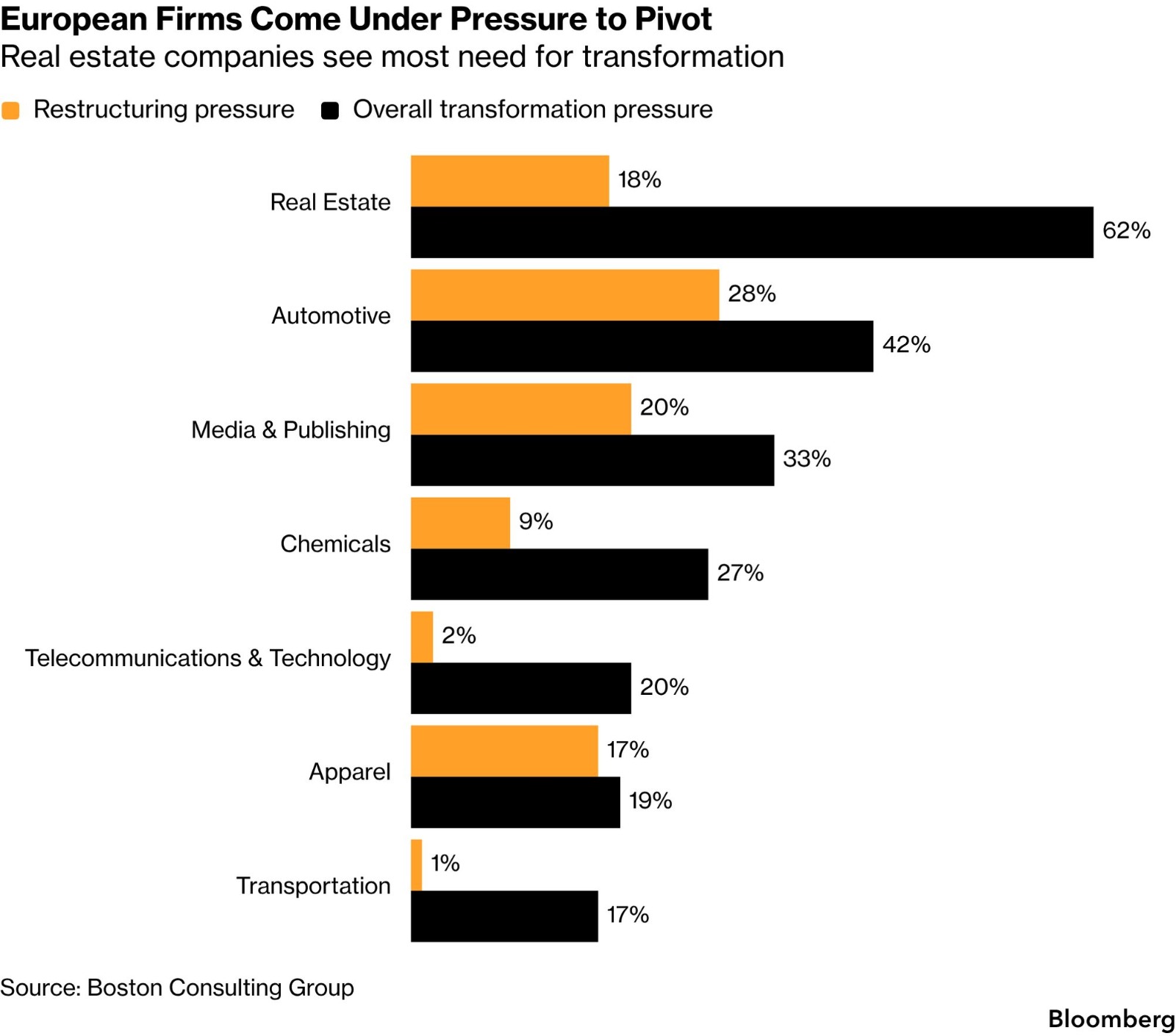
No sector illustrates this better than real estate. BCG finds 62% of real estate firms now need major shake-ups, a fivefold jump from just 12% a year ago.
Commercial property values across Germany, France and the Nordics are down 20-40% from 2022 peaks. Office vacancy in Frankfurt, Paris La Défense and Stockholm remains elevated as hybrid work sticks. Developers who borrowed at 1.5% to build at record land prices now face refinancing at 5% against falling collateral values.
It's a classic balance-sheet recession in miniature.
Who's Most Exposed?
Geography matters. Spain and Portugal show the widest spread of stress at 22% of companies affected, reflecting high leverage among mid-caps and tourism-linked property.
France, Germany, Austria and Switzerland have fewer companies affected overall, but those that _are_ hit face sharper restructuring risk – meaning deeper operational overhauls, asset sales, or debt-for-equity swaps, not just cost cuts.
This matches BCG's 2025 index pattern: Germany faced the highest restructuring risk, driven by automotive, chemicals, and consumer & retail – sectors accounting for over a third of the €300bn GDP at risk. Italy and the Nordics saw sharp rises due to telecom and energy giants. fc48
Sectors most at risk remain familiar: consumer & retail, automotive, chemicals, and transportation & logistics – all exposed to weak Chinese demand, US tariffs, and energy-intensive production.
Why This Time Feels Different
Europe has had debt scares before – 2012, 2020. Three things make 2026 different:
*1. No ECB put:* Unlike 2020, the ECB is not cutting aggressively. Core inflation stuck near 2.5-3% and fiscal deficits limit room to ease.
*2. Earnings, not just rates:* This is not just a financing shock. Underlying operational performance is weak. BCG's index combines P&L stress _and_ balance-sheet fragility. European industrials face structural loss of competitiveness on energy costs vs the US.
*3. Maturity wall:* Much of the 2020-2021 borrowing was 5-year money. That wall hits in 2025-2026. Refinancing means accepting rates 300-400bps higher.
What Happens Next?
BCG's message to CEOs, via senior partner Renaud Montupet, is blunt: "act fast to shore up balance sheets and cash positions if they want to enter 2026 from a place of strength". fc48
Expect three waves:
1. *Self-help:* Dividend cuts, capex freezes, working capital squeezes, disposals of non-core assets. Already underway.
2. *Amend-and-extend:* Banks will grant covenant waivers – for a fee – to avoid crystallizing losses.
3. *Restructuring:* For the 6-7% in severe distress, debt-for-equity, asset carve-outs, and pre-pack sales. Germany's automotive suppliers are prime candidates.
For investors, this is both risk and opportunity. Distressed debt funds are raising record European war chests.
For policymakers, it's a warning: Europe's real economy is more leveraged than headline GDP suggests. A new shock would transmit fast from corporate balance sheets to banks to jobs – BCG estimates 3.5 million jobs sit in at-risk firms.
Europe partied on cheap money. The hangover has just begun.